peterigz

Forum Replies Created
-
AuthorPosts
-
January 27, 2015 at 10:46 am in reply to: This guys is selling TimelineFX presets as sprite sheets #5326
peterigzKeymasterHi, thanks for letting me know 🙂
There’s actually nothing in the license that says you can’t do this, all the pre sets are royalty free and you can do what you want. It does give me the idea though that I should make a pack of all the free effects and put them on the envato market place (and others) and promote TimelineFX at the same time. I like to keep the license quite open and uncomplicated.
Maybe this person is quite lazy to just put them up like that but then I am too for not doing the same and advertising TimelineFX more at the same time! 🙂
This year I will be pushing TimelineFX more (I’m now freelance so hoping I can allocate more time), and bringing more new effects and the long-in-the-making Particle shapes section of this site 🙂
peterigzKeymasterHi, sorry there’s currently no library available for iOS direct integration. Right now my plans (time permitting) are to update the editor with some new features and to make available for particle shapes and effects libraries.
peterigzKeymasterHi, there are currently no plans to support Gamemaker, sorry. My next focus will be to make some improvements to the editor and produce particle shapes separately. I may look at integrating with other game engines at a later date though.
peterigzKeymasterHi, “uniform” is whether or not the particle size is square, so the width will always equal the height. If you right click on the particle attribute list you can select “Toggle Aspect”, meaning you can disble and enable maintaining the aspect ratio of the particle. Once toggled off, width and height attributes appear in the list.
I must apologise here for the naming convention of these variables as they’re not great! the base_size_x/y refers to the width and height attribute, scale_x/y_overtime is the width and height overtime attributes, you also have size_x/y_variation for the width and height variation attributes.
The sizex and sizey variables are the global particle width and height attributes for the effect – again you have to toggle off the aspect, otherwise it will just say global particle size.
If uniform is true it will always use the ‘x’ variable to set both width and height.
Hope that helps!
peterigzKeymasterHi, are you referring to the Blitzmax documentation? That may be a little out of date I will check.
peterigzKeymasterI will make the license window bigger for the next version. I haven’t bothered with windows 8 yet so I missed that bug 🙂
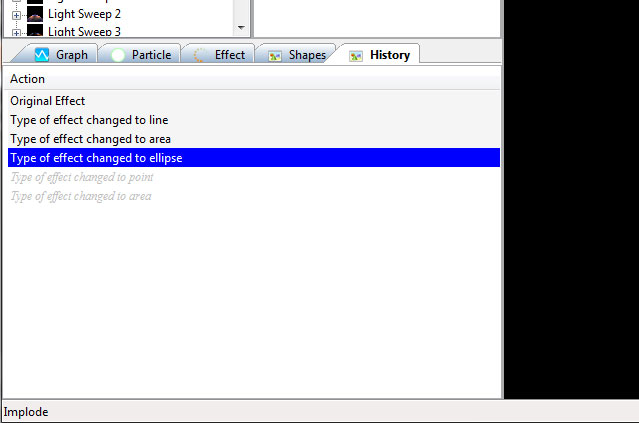
peterigzKeymasterYes I’m sure I will. I’ll be releasing a new update in the next couple of weeks that will feature a new history tab that will be like an undo system. Each time you edit an effect it creates a snapshot of it. This history can be saved with the effects so any new libraries I release will give some insight into how each effect was created. An early screenshot:
peterigzKeymasterThe .eff files are basically zip files you can open up. Inside there you’ll find the data.xml file that has all the emitter data for all the effects.
peterigzKeymasterOk sorry I miss-read your post 🙂
There are only officially supported libraries for direct use of the effects available for blitzmax and monkey programming languages, but there is also a c++ library contributed by a community member on GitHub here https://github.com/damucz/timelinefx
Which language are you coding in?
peterigzKeymasterHi Rob, the trial version allows you to export 4 frames to test with. If you need more I can upload a sprite sheet for you to test with if you want.
peterigzKeymasterHi, are you using the c++ library from here: https://github.com/damucz/timelinefx
Unfortunately I’m not a c++ coder so don’t know much about it, but that library seems to work ok and might be easier to set up. There’s more details in the thread here: http://www.rigzsoft.co.uk/forums/topic/c-engine/
peterigzKeymasterI had a quick go, I used an emitter from the environment library (Splash) and played about with it, using it as a sub effect to create some big splats. grab it here: Blood Splats
Might be nice to add a few chunks in there if you can find the right particle shape 🙂
-
This reply was modified 11 years, 11 months ago by
peterigz.
peterigzKeymasterHi Castor, do you mean like slow-motion? Not really, if something runs in slow-motion then by it’s nature it will take more frames, unless I’m understanding wrong.
peterigzKeymasterHi,
Hmm, it renders everything 32bit except for when it exports gif which are limited palette. Currently there’s no way of changing that, but there might be a way of doing it in photoshop or something similar after you’ve exported the sprite sheet. Or there could be sprite editors out there that have specific features for reducing the colour in an image?
peterigzKeymasterAhh ok I forgot about that! If you have the latest version of Timelinefx then when you save your effects library use the Export option from the file menu. This will save a stripped down zip version especially for monkey.
-
This reply was modified 11 years, 11 months ago by
-
AuthorPosts
